
The Agentic Commerce Frontier 📅 | July 14 - July 20


Welcome back friends and thank you for reading The Agentic Commerce Frontier!
Over the past week, payment networks introduced new issuer, settlement and testing infrastructure; merchants added agents directly to customer-service, ordering and storefront systems; and investors continued backing finance, voice and security platforms built around autonomous execution. At the same time, new research and industry initiatives sharpened the unresolved questions around identity, authorization, liability, fraud, product-data quality and transaction evidence.
In this week’s Agentic Commerce Primer, I explore how “Agentic Commerce may turn Demand into Inventory”. As always keen to get your thoughts!
🔥 TL;DR
Mastercard is preparing a UK agentic-commerce sandbox where merchants and developers can test product discovery, payments and dispute handling before going live
My takeaway: Sandboxes are useful, but they also reveal how far agentic checkout still is from being production-ready
Nearly half of surveyed consumers used AI while researching their latest online purchase, but willingness to hand over control drops sharply near payment.
My takeaway: People want AI advice, not AI control. Autonomous checkout is still mostly a vendor ambition
Hexagon found that 2% of ecommerce brands captured 60% of citations across 100,000 AI recommendations
My takeaway: AI discovery may be less democratic than search. A small group of brands could own the digital shelf
A-Comm opened its Agentic Commerce Evidence Protocol for public comment, proposing a tamper-evident record of intent, delegation, authorization and fulfillment
My takeaway: So much value in the invisible layers, such as this one. Proof of what the agent was allowed to do
Reuters examined how PayPal’s slow response to AI and agentic commerce weakened its strategic position
My takeaway: Not sure how they arrive at that conclusion. Seems far fetched to me
🤖 Agentic Commerce Primer: Agentic Commerce Will Turn Demand Into Inventory
The next marketplace may not list products. It may list funded customer mandates and let merchants compete to fulfil them.
TL;DR: Digital commerce made supply structured, searchable and instantly available. Demand remained fragmented across searches, clicks, abandoned carts and wishlists. AI agents could change that by converting consumer needs into persistent, machine-readable purchase mandates. Once demand can be verified, indexed, matched and executed, merchants no longer have to wait for customers to find their inventory. They can compete directly for the right to fulfil customer intent.
Every digital marketplace begins by organizing supply.
Amazon catalogues products. Airbnb catalogues available nights. Uber represents driver capacity. Advertising exchanges turn future impressions into units that can be priced and allocated.
Supply has attributes, availability, prices and fulfilment conditions. It can be searched, ranked, reserved and purchased.
Demand is treated differently. It arrives as a query, click, session or abandoned cart. Platforms infer its quality, merchants pay to intercept it and analytics systems record what remains after the customer leaves.
Demand is mostly exhaust.
Agentic commerce could change that.
A consumer may tell an agent:
Find a waterproof parka in size medium, suitable for temperatures below minus five degrees, delivered to Paris before Friday. Prefer recycled materials. Spend no more than €250, including delivery. Buy automatically if every condition is met.
That instruction contains specifications, preferences, a budget, a deadline, substitution rules and permission to transact. It can persist after the conversation ends, wait for the market to respond and execute when its conditions are satisfied.
The product feed made supply machine-readable. The agent mandate makes demand machine-actionable.
Once demand becomes persistent, permissioned and executable, it can be indexed. Once indexed, merchants can compete for it.
Demand starts to behave like inventory, not inventory in the accounting sense, but market inventory: a finite, discoverable pool of executable commercial opportunities.
From fleeting intent to a commercial object
Commerce platforms already recognize that an agent needs more than a payment credential. It needs evidence of what the user asked it to do.
Google’s Agent Payments Protocol introduced the Intent Mandate: a signed record of user instructions that may include price limits, timing and other conditions. For delegated purchases, the mandate can authorize an agent to act later when those conditions are met.
This is usually described as a trust mechanism. But a mandate has another property.
It turns consumer demand into an object.
A serious mandate might contain:
the required outcome;
acceptable products and substitutes;
price and total-cost limits;
fulfilment conditions;
merchant eligibility rules;
payment authority;
expiry and revocation;
disclosure permissions;
proof that the demand is genuine.
Until now, most of this information existed only inside the customer’s head, browser session or conversation.
Once structured, it can enter the market directly.
This is not a wishlist
A wishlist records something a customer might buy. A saved search watches for matching supply. A lead indicates possible interest. A cart contains products already under consideration.
A mandate is stronger.
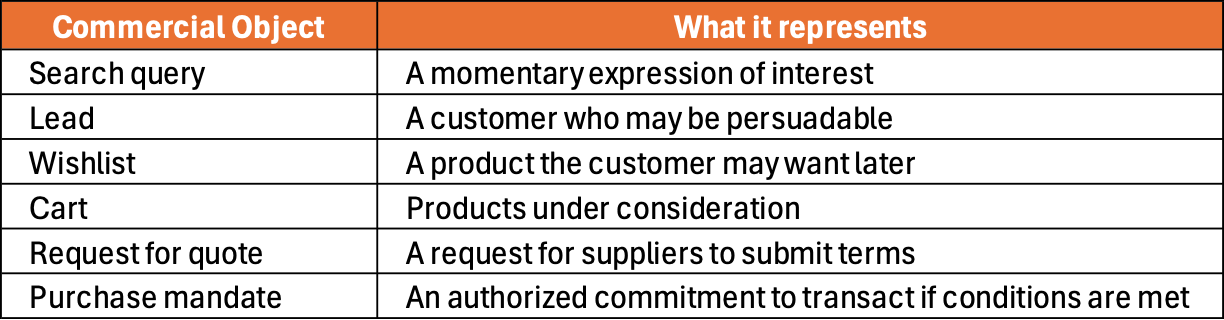
The difference is executability.
A lead still requires persuasion. A mandate already defines the conditions under which the consumer is prepared to act.
Clicks are signals. Mandates are instruments.
Nor is this simply a reverse auction. Reverse auctions let sellers compete for a defined buyer request, usually on price. An agentic mandate could be continuous, multidimensional and autonomous. It might weigh price, quality, delivery, returns, sustainability and loyalty benefits, remain active for months and execute without the user reopening an application.
A reverse auction is one mechanism that could operate on top of mandates.
The important innovation is the mandate itself.
The mandate order book
Financial markets organize demand through orders. A limit order specifies an asset, quantity, maximum price and duration, then waits for a matching seller.
Consumer mandates could create a richer version of the same structure.
One side of the market would contain merchant offers: products, prices, availability, policies and fulfilment promises.
The other would contain customer mandates: outcomes, constraints, budgets, permissions and expiry dates.
Between them would sit a matching system.
Unlike a financial order book, it would rarely organize around price alone. A €180 jacket delivered tomorrow may be preferable to a €150 jacket delivered next week. A flexible hotel booking may be worth more than a cheaper non-refundable room.
The matching engine would optimize across:
effective price;
product fit;
fulfilment certainty;
returns and cancellation rights;
merchant reputation;
compatibility;
payment terms;
consumer preferences.
This is closer to procurement than conventional online shopping, but performed continuously and at consumer scale.
The customer’s agent becomes a professional buyer. The merchant’s agent becomes a responsive seller. The marketplace becomes the venue where machine-readable supply meets executable demand.
Merchants will search for customers
Today, a merchant publishes products and waits for customers to arrive. It spends on search, retail media, affiliates and promotions to improve the odds of discovery.
Mandate exchanges could invert that model.
A merchant agent might subscribe to qualified demand:
Show me active mandates for waterproof outerwear, deliverable from my European warehouses, with budgets between €150 and €300, where the customer permits direct offers.
The merchant could respond with a product, private discount, bundle, faster fulfilment or conditional offer.
The customer would not need to visit the merchant’s storefront first.
The merchant would visit the customer’s mandate.
Google’s Direct Offers already points in this direction by letting retailers surface tailored discounts and bundles to shoppers identified as ready to buy. Its Agent Payments Protocol also describes merchants responding to structured consumer intent with time-sensitive offers.
But those systems still begin inside a platform-controlled experience. The platform identifies the shopper, determines relevance and decides which merchants may respond.
A true mandate exchange would make the demand object portable and addressable, subject to the consumer’s rules.
The shift is from merchants buying access to audiences to merchants competing for permission to fulfil explicit demand.
The listing becomes a response function
Product listings are designed for people browsing catalogues. In a mandate market, merchant systems must answer a more dynamic set of questions:
Can this exact outcome be fulfilled? What substitutions are possible? What price can be offered? Can delivery be accelerated? What guarantees can be made?
The listing becomes less like a static page and more like a response function.
Given a verified mandate, the merchant calculates the best offer it is willing and able to make.
Current protocols are building some of the underlying language. Google’s Universal Commerce Protocol standardizes carts, checkout and order management and can support quote generation. OpenAI’s commerce infrastructure asks merchants to publish structured product feeds so agents can discover, compare and purchase products conversationally.
These systems make supply legible to agents.
The next frontier is allowing supply to respond programmatically to demand.
What changes when demand becomes inventory
Distribution becomes access to mandates
In the current model, distribution means shelf space, search ranking, traffic or audience access.
In a mandate market, the scarce resource is permission to see and respond to qualified demand.
Consumers might allow any verified merchant to compete, restrict access to preferred sellers or invite only a few bidders. Merchants may pay for access, pay after winning or offer better terms to be considered.
Retail media does not disappear. It moves closer to the transaction.
The new sponsored position may be the right to submit an offer against a mandate.
Pricing becomes bilateral
Mandates make individualized terms easier.
A merchant could discount to secure incremental demand, bundle excess inventory or improve terms when a mandate is close to expiry. Consumers may benefit from stronger competition and offers shaped around their actual requirements.
The same infrastructure could enable aggressive price discrimination.
A mandate revealing urgency, limited alternatives or a high maximum budget may let merchants capture more consumer surplus. The shopping agent must therefore disclose enough information to attract valid offers without exposing the buyer’s full negotiating position.
Demand can become inventory only if access to it is controlled.
Forecasting improves
Search volumes, page views and carts mix curiosity with genuine intent.
A verified mandate is stronger because it defines the conditions under which a transaction will occur.
Aggregated carefully, mandates could help merchants forecast demand, allocate stock and plan fulfilment before purchases happen. Manufacturers might identify unmet demand for product configurations they do not offer. Retailers might reposition inventory towards regions where qualified demand is accumulating.
The mandate book becomes a forward view of commerce.
Marketplaces move to the buy side
Traditional marketplaces aggregate supply and bring customers to it.
A mandate exchange aggregates customers and brings suppliers to them.
Instead of controlling the digital shelf, the operator controls access to organized purchasing intent. At scale, it could negotiate prices, service levels and return terms for millions of consumers.
A personal-agent platform could become a vast procurement organization.
The next dominant commerce platform may not own the largest catalogue.
It may represent the largest pool of executable demand.
Who captures the economics?
The business model depends on which side values liquidity most.
A supplier-funded exchange might charge merchants to access mandates, submit offers or win transactions. A consumer-funded model might charge for representation, savings or procurement services. A transaction-funded model could monetize successful matches, payments, financing, insurance or fulfilment guarantees.
The strategic question is not merely who operates the exchange.
It is who pays for the right to organize demand.
If merchants fund it, the exchange may drift towards maximizing conversion and supplier yield. If consumers fund it, it can align more directly with price, quality and consumer surplus. If it monetizes both sides, governance becomes part of the product.
The revenue model will shape whose mandate the exchange truly serves.
The hard problems
Fake demand
Merchants will not compete seriously for requests unlikely to execute. Mandates may need proof of payment authority, deposits, rate limits, reputation or evidence that the agent has permission to act.
The market must distinguish executable demand from machine-generated noise.
Privacy
A detailed mandate can reveal income, health needs, location, travel plans and willingness to pay.
The exchange cannot treat the full mandate as public inventory. Some attributes may be disclosed only after a merchant qualifies. Others may be proven without being revealed.
The challenge is to create liquidity without creating a market in consumer vulnerability.
Comparability
The lowest price is not always the best outcome. Offers may differ on quality, delivery, returns, compatibility and risk.
The exchange will need structured scoring and explicit trade-off rules rather than a simple auction.
Fragmentation
A mandate has little value if it reaches only a handful of merchants, while merchants cannot integrate separately with hundreds of agent platforms.
Shared standards can reduce fragmentation, but they also encode power. Whoever defines the mandate schema influences which forms of demand can be expressed and which attributes the market can optimize.
The protocol is part of the market design.
Adverse selection
If consumers publish mandates only for unusually difficult or low-budget purchases, and merchants reserve their best offers for expensive-to-acquire customers, the exchange could become a market of last resort.
Liquidity must include routine, high-quality demand on both sides.
The infrastructure that gets built
A mandate exchange would require several components:
a mandate issuer that turns instructions into a signed object;
a qualification layer that verifies authority and payment readiness;
a disclosure controller that governs which merchants see which attributes;
a matching engine that compares suppliers and offers;
an offer engine through which merchants respond;
an execution layer that converts the winning offer into payment and order;
a lifecycle system for expiry, revocation, disputes and changing requirements.
Some platforms will build this vertically. Others will provide neutral infrastructure across agents and merchants.
The most valuable layer may be the venue that attracts enough verified mandates and merchant responses to create liquidity.
That is the mandate exchange.
What this means for the market
For merchants, the operating question changes from “How do we rank for a product search?” to “How do we become eligible to respond to high-quality mandates?”
That requires real-time offer engines, reliable inventory, machine-readable policies and binding fulfilment promises.
For consumer-agent builders, the mandate becomes the core asset. The agent that best understands, structures and protects demand may matter more than the one with the most elegant interface.
For payment networks and financial institutions, mandates create a role before checkout. They can verify authority, attest to funding, enforce spending conditions and connect the transaction to a clear chain of intent.
For investors, the opportunity extends beyond shopping assistants to mandate issuance, demand exchanges, merchant bidding tools, offer optimization, privacy-preserving matching, mandate insurance and analytics derived from unmet demand.
The category is not simply agentic checkout.
It is demand infrastructure.
The market begins on the other side
Digital commerce spent three decades organizing supply around one assumption: merchants publish what they have, and customers come looking for it.
Agents weaken that assumption.
A consumer’s need no longer has to disappear after a search session. It can persist as a structured instruction with a budget, deadline, authority and set of conditions. It can invite competition and execute when the market meets its terms.
The merchant no longer asks only, “How do I attract a customer?”
It can ask, “Which active mandates can I satisfy better than anyone else?”
The next marketplace may contain no visible catalogue. Its core inventory may be unmet needs, funded instructions and conditional commitments waiting for the right supplier.
Commerce has always treated products as inventory and demand as traffic.
Agentic commerce may reverse the asymmetry.
It will turn demand into inventory.
🚀 Major Announcements & Funding News
Mastercard prepares a UK testing environment for agent-led commerce: Mastercard plans to make its Proto sandbox available in the UK in August, allowing businesses to test how products are represented and discovered by agents, how payments are authenticated and how disputes are handled. The network is also developing shopping, merchant-onboarding and dispute-focused agents (Mastercard)
Thredd brings Visa Agentic Ready capabilities to European issuers: The issuer-processing platform joined Visa’s programme with Zilch among its initial participants. The integration is intended to support agent-initiated transactions, passkey-based authentication and network controls without requiring issuers to rebuild their underlying infrastructure (Thredd)
Visa introduces a bank-branded AI financial assistant: Visa’s white-label assistant lets financial institutions offer natural-language account queries, personalized spending insights and guided actions such as locking a card or configuring alerts. US pilots are expected to begin in August, with subscription-management functions planned subsequently (Visa)
Rime raises $24 million to improve enterprise voice agents: M13 led the Series A, with participation from Corazon Capital, Unusual Ventures, Cadenza Ventures and Twilio Ventures. Rime is developing speech models intended to reduce latency and improve expressiveness in customer-service, sales (Rime)
PayPal board reportedly resists the Stripe-Advent takeover proposal: PayPal’s board views the approximately $53 billion offer as insufficient and potentially difficult to finance or clear with regulators, according to Reuters. A successful combination would connect Stripe’s merchant-processing footprint with PayPal’s consumer wallet, Venmo and broader checkout distribution (Reuters)
Strivve brings issuer card preference into agentic checkout: The company is extending Top of Wallet so participating issuers can make their card available as the preferred credential when a trusted agent shops across long-tail merchants. Strivve says the system builds on PCI DSS-compliant credential-placement infrastructure serving more than 200 issuers while keeping credential controls at the financial-institution level (PR Newswire)
Beacon Security raises $13 million for an agentic security data platform: Notable Capital led the seed round, with participation from AlphaDrive Ventures, Holly Ventures, Jefferies Family Office, SVCI and angel investors. Beacon normalizes and enriches telemetry for human analysts and specialized agents that build detections, investigate incidents and examine shadow-AI activity (SecurityWeek)
Solana Foundation and Google Cloud Korea organize an x402 commerce build programme: The hackathon asks developers to create agents capable of discovering cloud APIs, authenticating access and paying in USDC on a usage basis. The design combines Pay.sh’s service catalog, x402 settlement and programmable spending limits, making API procurement a practical test case for machine-to-machine commerce (Solana Compass)
Tec-Do introduces Navos 2.0 as a multi-agent commerce operating system: Announced at the World Artificial Intelligence Conference, Navos 2.0 coordinates specialized agents across international growth, marketing, sales and service workflows. The company is positioning the system as an execution layer for brands operating across multiple markets rather than as a standalone content-generation product (PR Newswire via The Straits Times)
A-Comm proposes an open evidence layer for agent-led transactions: The Apache 2.0-licensed A-Comm Evidence Protocol converts discovery, referral, intent, delegation, policy, cart, authorization and fulfillment events into a tamper-evident chain sealed at authorization. The resulting record is designed to be exported and independently verified by merchants, networks, issuers or dispute participants (PR Newswire)
Bluehost brings merchant-operating agents to its small-business platform: Its AI Store can create and manage a WooCommerce storefront through conversation, track orders, catalogs, customers, payments and channels, and flag missing prices or low stock. A separate Front Desk Agent answers questions, qualifies leads and books appointments against live calendar availability (PR Newswire)
Loman AI integrates restaurant voice ordering with Toast: The generally available integration lets Loman answer calls, process menu modifiers and combinations, take secure payment and route the order into the same Toast workflow used by in-person and digital channels. Loman reports that its service is live across more than 1,500 restaurants (Business Wire)
UnionPay presents an Agentic Payment Open Protocol framework: At WAIC 2026, UnionPay showcased its APOP framework alongside a financial transaction time-series model and privacy-preserving model-inference technology. Its broader financial-AI programme includes payment, risk-management, merchant-transformation and controlled testing capabilities (Media OutReach Newswire)
visualAI launches an MCP-native commerce-discovery platform: discoverGPT combines a canonical merchant catalog, a unified REST interface and a 24-tool MCP gateway supporting natural-language and visual search, data enrichment, agent-facing feeds and virtual try-on. The company is positioning the system as merchant-controlled discovery infrastructure across both onsite experiences and external agents (EIN Presswire)
🛡️ Security & Fraud
Agent hijacking and automated abuse could outpace human-era fraud controls: Ravelin CEO Martin Sweeney identifies compromised agents, fake agents, promotion abuse and automated refund manipulation as emerging attack paths. Because agents can operate at machine speed and across multiple merchants, risk systems will need to authenticate both the software actor and the scope of its authority (TechRadar Pro)
Existing contract law leaves material questions around agent authorization: Ballard Spahr’s legal analysis examines whether an agent can provide meaningful assent, how notice should be delivered, when agency law or ratification applies and what evidence merchants must retain. Repeated automated errors could also aggregate into significant consumer-remediation or class-action exposure (Consumer Finance Monitor)
Payment authorization needs identity, mandate and auditability at the agent layer: mintBlue argues that conventional checkout infrastructure can identify accounts and process payments without proving which agent acted, what the consumer authorized or whether the action remained inside the original mandate. Durable transaction records will need to connect the user, agent, instruction and resulting payment (mintBlue)
Payment-integration agents still struggle with risk-hardening requirements: Alipay-PIBench evaluates six coding models across nine Alipay projects and 18 realistic integration tasks, including advanced security and risk scenarios. Supplying structured payment-domain guidance increased the mean rubric pass rate by 10.31 percentage points, indicating that secure integrations remain highly dependent on specialized context (arXiv)
Autonomous agents are being deployed faster than security teams can inventory them: ISMG’s Pulse Report says vulnerability disclosure-to-exploitation windows have compressed to less than a day in some cases, while enterprises may operate hundreds of SaaS products capable of introducing third-party agents (BankInfoSecurity)
APAC payment companies establish a forum for agent liability and authorization: The Emerging Payments Association Asia launched the AI and Agentic Payments Working Group with HSBC as a founding member. Its agenda includes identity and authentication across borders, mandate breaches, new fraud models, dispute handling and the allocation of liability among consumers, agents, merchants and payment providers (ACN Newswire)
Chargeback evidence may need to prove both authority and compliance with intent: Chargeflow distinguishes permission for an agent to shop from approval of a specific product, price and merchant. Its proposed evidence set includes the consumer’s delegation, spending and category limits, approval requirements, proof that the agent remained within scope and records showing when the consumer was notified (Chargeflow)
📈 Consumer & Market Insights
Consumers use AI for research but retain control at payment: Research covering 5,241 consumers, 1,185 merchants and 150 acquirers across the United States, Brazil and the United Arab Emirates found that nearly half of shoppers used AI during their latest online purchase journey (PYMNTS)
Retail gifting experiences remain poorly optimized for AI discovery: Blackhawk Network and NAPCO evaluated 120 brands across 19 categories and 147 criteria. Although 33% of surveyed gift shoppers reported using AI to compare products or locate prices, only 61% of evaluated brands met the benchmark’s AI-search criteria and 5% provided AI-assisted gifting recommendations (Blackhawk Network)
Onchain agent payments are producing high transaction counts at very low values: Visa and Artemis distinguish human-scale commerce from emerging machine-to-machine activity. Their analysis reports approximately $15 million across 109.6 million x402 transactions and roughly $25,000 across 115,000 Machine Payments Protocol transactions, implying average values measured in cents or fractions of a cent (Visa)
Merchant protocol support drops sharply at the payment layer: UCPChecker’s July census identified 11,414 verified agent-readable stores, with broad support for checkout, order and cart capabilities. Only 15 declared identity functionality and none declared payment support, illustrating the distance between exposing a catalog to agents and allowing them to complete authorized transactions (UCPChecker)
AI shopping usage is high, but consumers continue auditing its evidence: An LDWW survey of 2,000 US adults found that nearly seven in ten respondents use AI to shop and 30% have used it to complete a purchase. More than half inspect citations supplied by AI tools, while almost 60% consider the identity of underlying sources important (FashionUnited)
Familiarity with general AI is not translating directly into trust in shopping assistants: Bain Consumer Lab findings cited by Retail Customer Experience indicate that 70% of consumers use AI personally and 45% use it daily, with stronger confidence in research assistance than autonomous shopping. Large retail platforms may nevertheless normalize agent use by incorporating it into existing, trusted customer relationships (Retail Customer Experience)
Back-to-school shoppers are using agents mainly for research and comparison: MediaPost reports that 73% of parents plan to use AI somewhere in their seasonal shopping workflow, while Tinuiti found that 68% use conversational AI for tasks such as locating deals, comparing products and summarizing reviews. Only 9% of consumers in separate Accenture research were open to fully autonomous purchasing, preserving a clear boundary between assistance and payment authority (MediaPost)
AI recommendations appear highly concentrated among a small group of brands: Hexagon says its analysis of 100,000 recommendations across ChatGPT, Perplexity, Claude and Google AI surfaces found that 2% of ecommerce brands received 60% of citations. The vendor-operated study identifies structured product information, third-party corroboration and consistent entity data as recurring signals, although the findings have not been independently audited (Hexagon)
Retailers are experimenting with conversational AI faster than they are integrating the customer journey: Infobip and Retail Economics argue that messaging is moving from one-way notification toward a persistent service and commerce channel. Their release cites strong WhatsApp engagement and a small industry poll in which all eight participating retailers said they had not fully integrated conversational AI across the complete journey; the narrow sample should be treated as directional (Business Wire)
Weak identity resolution can materially distort AI-driven marketing decisions: Research from the Marketing + Media Alliance and LiveRamp found that incomplete or inaccurately linked data can change channel rankings and understate campaign performance. In synthetic tests, poor identity precision reduced measured campaign ROI by approximately 70%, demonstrating how agents optimizing against faulty attribution could automate the wrong budget decisions (Business Wire)
PayPal’s competitive challenge extends beyond the reported acquisition approach: Reuters traces the company’s position to slower innovation, pressure from Apple Pay and other checkout competitors, plateauing user growth and delayed movement into agent-mediated commerce (Reuters)
🎯 Strategic Hiring Highlights
Product / platform / architecture – Agentic Commerce
American Express — Senior Associate, Digital Product Management, Agentic Commerce — New York, NY (hybrid) — Salary range listed in posting — American Express Careers
American Express — Director of Product Development, Agentic Commerce Growth & Emerging Capabilities — New York, NY — $144,250–$256,250 — American Express Careers
Citi — Senior Vice President, Product Development – Wallets & Agentic Commerce | US Consumer Cards — New York, NY (hybrid) — $176,720–$265,080 — Citi Careers
Amazon — Principal Product Manager Technical, Agentic Commerce Experiences — Seattle, WA — Salary band not listed — Amazon Jobs
Amazon — Senior PMT, Agentic Commerce Experiences — Seattle, WA — $151,200–$204,600 — Amazon Jobs
Wesfarmers Digital — Agentic Commerce Product Manager — Sydney, Australia (hybrid) — Salary not listed — Wesfarmers Digital Careers
Gap Inc. — Principal – Architecture (AI, Unified Commerce) — San Francisco, CA — $209,700–$272,600 — Gap Inc. Careers
Checkout.com — Product Manager, Agentic Commerce — London, UK — Salary not listed — Checkout.com (Ashby)
Accenture — Commerce Architecture & Delivery Senior Manager | Agentic Commerce — Multiple US locations (incl. Chicago, IL) — Salary not listed — Accenture Careers
Accenture — Agentic Commerce Senior Manager | Consumer Goods & Retail — Multiple locations (incl. Chicago, IL) — Salary not listed — Accenture Careers
Accenture — Technical Commerce & AI Manager | Agentic Commerce & AI — Multiple locations (incl. Chicago, IL) — Salary not listed — Accenture Careers
Accenture — Agentic Commerce Manager | Comms, Media, & Technology — Multiple locations — Salary not listed — Accenture Careers
Accenture — Agentic Commerce Consultant | Comms, Media, & Technology — Multiple locations — Salary not listed — Accenture Careers
Accenture — Agentic Commerce Consultant | Consumer Goods & Retail — Multiple US locations — $68,000–$205,800 — Indeed / Accenture
Accenture — Growth Tech & Agentic Commerce Advisory Senior Manager — Germany / Austria / Switzerland — Salary not listed — Accenture Careers
Accenture — Growth Tech & Agentic Commerce Advisory Consultant — Germany / Austria / Switzerland — Salary not listed — Accenture Careers
GTM / commercial – Agentic Commerce
Stripe — Business Development Manager, Agentic Commerce — San Francisco, CA; Seattle, WA; or Remote US — $310,100–$465,100 OTE — Stripe Careers
Adyen — Strategic Growth Manager, Agentic Commerce — San Francisco, CA — $190,000–$240,000 + RSUs — Adyen (Greenhouse)
Adyen — Strategic Growth Manager, Agentic Commerce — New York, NY — $190,000–$240,000 + RSUs — Adyen (Greenhouse)
Forter — Senior Strategic Partnerships Manager, AI and Agentic Commerce — Remote, US (NY or London preferred) — $180,000–$220,000 + bonus + equity — Forter (Greenhouse)
Engineering / infra – Agentic Commerce
Target — Sr Engineer, Agentic Commerce — Brooklyn Park, MN — US$98,000–US$176,000 — Target / Glassdoor
SAP — Senior Product Specialist, Agentic AI – Retail (f/m/d) — Walldorf, Germany — Salary not disclosed — SAP Careers
SAP — Product Expert, Agentic AI – Retail (f/m/d) — Walldorf, Germany — Salary not disclosed — SAP Careers
📖 Articles Worth Reading
How Agentic AI Transforms Marketing: BCG examines how brands will compete when agents increasingly mediate customer research, evaluation and purchase decisions. The article’s strongest implication is that performance will depend on machine-readable evidence, reliable product information and the ability to operate across agent-controlled interfaces (Boston Consulting Group)
Why Trust Is the Real Bottleneck in Agentic Commerce: Stibo Systems connects agent reliability to the quality, governance and lineage of product data. Agents cannot make defensible recommendations or execute purchases when product attributes, availability, policy and compliance information are inconsistent across systems (Stibo Systems)
Agentic Commerce Signal Report, H1 2026: TruCommerce reports observations from 85 brands, 2,412 monthly shopping queries across six agent surfaces and server-side attribution for approximately 30 brands. Its finding that legacy analytics may undercount AI-influenced revenue is directionally important, although the cohort is vendor-operated and the methodology has not been independently validated (TruCommerce)
Can Phia’s Affiliate Model Survive the Scandal?: Puck examines the commercial fragility of affiliate-funded shopping agents when attribution integrity is disputed. The broader issue is whether agents can simultaneously act as trusted consumer representatives and participate in incentive structures tied to merchant conversion (Puck)
Google Cites Itself: The 2026 AI Mode Visibility Playbook: Digital Applied synthesizes vendor research suggesting that Google-hosted Business Profiles and Product Knowledge Panels are becoming dominant citation surfaces inside AI Mode. For merchants, the implication is that product schema, profile completeness, reviews and feed accuracy increasingly determine whether an agent sees the brand at all (Digital Applied)
Three Major Ecommerce AI Trends for Retailers: Epinium connects AI-originated traffic, structured product data and autonomous checkout into a single merchant operating model. The article is strongest when describing the fields agents require—price, inventory, delivery commitments and returns—rather than treating AI visibility as a conventional content-marketing exercise (Epinium)
Ecommerce AI in 2026: Broad Adoption, Selective Execution: Ecombrain distinguishes widespread assisted use from production agents operating with permissions, evidence and recovery paths. Its practical recommendation is to automate frequent, low-risk workflows first and increase authority only after operators can measure accuracy, approvals and failure handling (Ecombrain)
AI Shopping Agents: Why Context Comes Before the Query: Elastic argues that agents should receive precomputed catalog vocabulary, business policies, live availability, user profiles and session history before making their first tool call. The architecture reduces avoidable searches, invalid filters and recommendations for unavailable or previously returned products; the cited 75% token reduction comes from an analogous document benchmark rather than an ecommerce deployment (Elastic)
Deep Product Data Is the New SEO in the Age of AI Discovery: The article explains why attributes such as material composition, compatibility, sizing and use cases must be exposed as structured data rather than buried in copy or presentation tables. It also cites Adobe data indicating that US retail traffic from AI sources increased 393% year over year in the first quarter of 2026 (E-Commerce Times)
In Retail, Automation Isn’t the Problem—Untested Customer Journeys Are: The article argues that retailers must monitor the entire automated service journey, including routing, transfers, language handling and recovery paths. A capable model cannot compensate for broken telephony, unavailable escalation or downstream systems that fail after the agent has made a promise (Retail Customer Experience)
Agentic Commerce: Why AI Agents Are Transforming the Ecommerce Landscape: Worldline’s Jonas Martins examines the shift from recommendation toward transaction execution and the resulting requirements around payment authorization, merchant acceptance and consumer control. The piece is useful as a payment-provider view of where existing ecommerce infrastructure requires adaptation rather than wholesale replacement (TechRadar Pro)
🧭 Looking Ahead
NRF Nexus 2026
Date: July 22-24, 2026
Location: Colorado Springs, USA
Focus: Executive retail technology summit with AI commerce and agentic operating-model themes
Berkeley Agentic AI Summit 2026
Date: August 1-2, 2026
Location: Berkeley, CA
Focus: Agentic AI research, infrastructure, interoperability, governance, and academic-to-industry transfer
eTail Boston 2026 / eTail East
Date: August 10-12, 2026
Location: Boston, USA
Focus: Ecommerce and omnichannel operations, with AI commerce and digital-commerce execution themes
Stripe Tour Sydney
Date: August 19, 2026
Location: ICC Sydney
Focus: Payments, software platforms, AI-commerce tooling, and internet-economy growth
Stripe Tour Singapore
Date: August 25, 2026
Location: Sands Expo and Convention Centre
Focus: Regional payments, cross-border commerce, AI-enabled business infrastructure
W3C / GS1 Workshop: E-commerce for Humans and AI Agents
Date: September 8-9, 2026
Location: Zurich, Switzerland / hybrid
Focus: Standards, interoperability, product data, identity, and agent participation in ecommerce workflows
MRC San Diego 2026
Date: September 14–16, 2026
Location: Hyatt Regency Mission Bay Spa and Marina, San Diego
Focus: Payments, fraud prevention, chargebacks, merchant risk, and digital-trust operations
Agentic Commerce & Payments Summit 2026
Date: September 15, 2026
Location: Stockholm, Sweden
Focus: Agentic AI in commerce and payments, intelligent transactions, automation, fraud prevention, and AI-driven decisioning
Money20/20 USA 2026
Date: October 18–21, 2026
Location: Las Vegas, NV
Focus: Payments, fintech, financial services, connected commerce, banking partnerships, and money-movement infrastructure
General information only. Not legal, tax, investment, or professional advice. No warranty as to accuracy or completeness. Verify independently and consult your own advisers.
If you believe any information is inaccurate, please contact AgenticCommerce@proton.me and we will make a good-faith effort to review and correct it where appropriate.
Sponsored or affiliate content, if any, is disclosed.
MJ, love your rethinking of flipping the marketplace around and having merchants compete to meet demand, instead of demand going in search of supply. Great read today.
And thanks for the shoutout for a-comm! Readers can check out the specification at https://aep.a-comm.ai/