
The Agentic Commerce Frontier 📅 | July 7 - July 13


Welcome back folks! In this edition: Visa and Mastercard participated in live payment deployments, Akeneo repositioned product information management around coordinated agents, and new retailer benchmarking exposed how weak catalog accessibility can outweigh ecommerce scale.
In this week’s Agentic Commerce Primer, I cover “Intent Disclosure”. Agents may need intimate knowledge of your preferences, constraints and circumstances. But if you don’t want your agent to negotiate against you, that information does not need to be systematically disclosed.
Keen to hear your thoughts!
🔥 TL;DR
Animoca Brands and Visa launched a live agentic-payment pilot in Hong Kong, allowing AI agents to identify card rewards and complete purchases at selected merchants using tokenized credentials and permission controls
My takeaway: Issuers win upstream, by shaping what agents consider—not by smoothing checkout
Mastercard completed Moldova’s first payments executed by an AI agent with maib and Moldindconbank, using Agent Pay and its Know Your Agent framework
My takeaway: Agent identity is the easy part. Liability is the real bottleneck
Akeneo introduced an agentic product-experience platform in which its Ziggy agent coordinates product-data workflows under human governance
My takeaway: Better agents cannot fix bad product data. They only scale the damage
Digital Commerce 360 and ReFiBuy launched AI Commerce Rankings covering 1,000 retailers and measuring catalog accessibility, AI referral traffic, source diversity, and momentum
My takeaway: Agent visibility is not commerce performance. Conversion still decides
Rezolve AI launched Auditable AI for commerce recommendations, adding human-readable explanations grounded in customer preferences, product attributes, history, and business rules.
My takeaway: Explainability cannot rescue weak recommendations. It only makes them easier to audit
🤖 Agentic Commerce Primer: The Honest Shopping Agent is a Bad Negotiator
The best consumer agent will know everything about you …and reveal almost nothing.
TL;DR: Shopping agents need intimate knowledge of our preferences, constraints and circumstances to represent us well. But that same information can expose our urgency, willingness to pay and negotiating limits to merchants. The next trust problem in agentic commerce is not simply whether agents follow instructions. It is whether they protect the economic confidentiality of the people they represent.
Imagine asking an AI agent to book a hotel. It knows the trip is for your anniversary, the dinner reservation cannot be moved and your partner has injured their knee, so the hotel must be nearby and accessible. You have asked it to stay below €300 a night, but it also knows that you would reluctantly pay €450 rather than disrupt the trip.
That context makes the agent useful. It understands which constraints are real, which compromises are acceptable and which apparently attractive options would ruin the experience.
Now imagine it sends all of that information to the hotel’s pricing system. The hotel no longer sees a traveller comparing rooms. It sees a customer with a fixed date, limited alternatives, emotional urgency and a reservation price far above the stated budget.
Your helpful agent has just negotiated against you.
This is the contradiction inside the current vision of agentic commerce: the more an agent knows about us, the better it can represent us; the more it reveals, the easier we become to exploit.
The industry is working hard to make consumer intent machine-readable, portable and verifiable. Far less attention is being paid to a more uncomfortable question:
Which parts of that intent should never reach the seller?
Hidden intent is where the value sits
Real shopping intent rarely fits inside a prompt. “Find me a good hotel in Rome” may conceal requirements around location, accessibility, flexibility, breakfast, loyalty status, preferred brands and budget. The stated budget may be a target rather than a ceiling, and the real objective may not be to secure a room at all. It may be to avoid a disappointing anniversary.
A serious shopping agent will need to reconstruct that deeper objective using calendars, previous purchases, loyalty status, household circumstances, financial boundaries and long-term memory.
Recent shopping-agent research already reflects this complexity. EComAgentBench distributes consumer requirements across the initial request, stored profile data and later clarifications rather than exposing the full intent upfront. Even the strongest model tested completed only 57.1% of the benchmark successfully.[1]
The signal is clear: a capable shopping agent’s value will not come merely from searching a larger catalogue. It will come from understanding what the consumer actually means.
But that information has two economic uses. It has decision value for the buyer because it helps the agent make a better choice. It also has extraction value for the seller because it reveals urgency, flexibility and willingness to pay.
The agent needs to know that your maximum price is €450. The hotel does not.
Personalization and negotiation are different problems
The current commerce narrative treats richer consumer context as an unqualified improvement. Give the agent more memory, connect more data, make preferences portable and turn messy human intent into structured constraints.
All of that can improve relevance. But personalization and negotiation pull in opposite directions.
Personalization asks what the customer values. Negotiation asks how much of that value the counterparty should be allowed to see.
For a seller, the ideal customer is perfectly legible. The seller knows the customer’s urgency, alternatives, preferred brands, sensitivity to inconvenience, probability of abandoning the purchase and maximum willingness to pay.
For the buyer, that is a terrible negotiating position.
Merchants already try to infer these signals from browsing histories, location data, abandoned carts and previous transactions. Regulators have begun examining whether personal data and behavioural signals can generate individualized prices based on a consumer’s characteristics or apparent willingness to pay.[2]
Shopping agents could make that inference much easier. Tomorrow, the consumer’s own representative may arrive with a structured description of exactly what they need, why they need it and which compromises they will accept.
The merchant no longer needs to reconstruct the customer’s intent. The customer’s agent has brought it to the negotiating table.
Transparency is not the same as alignment
A trusted agent should be transparent, but primarily to the person who appointed it. The user should know what the agent inferred, what it disclosed and why.
That does not mean it should be equally transparent to every merchant.
A lawyer should be honest with the client without revealing the client’s settlement ceiling to the opposing side. A procurement team must understand the company’s budget without attaching it to every request for proposals. A buyer’s estate agent may know that the buyer desperately wants a particular property, but does not volunteer that fact to the seller.
The same principle should apply to AI agents.
The correct design goal is not universal transparency. It is fiduciary alignment.
The agent should treat the consumer’s maximum price, urgency, fallback position and emotional context as negotiation secrets. This does not require deception. It requires distinguishing between information needed to complete the transaction and information merely valuable to the counterparty.
There is a difference between the purchase constraint and the reason behind it, between a target price and a maximum price, between proof of eligibility and a complete customer profile, and between authority to transact and access to the user’s full financial position.
A trustworthy agent therefore needs two qualities that initially appear contradictory: complete honesty inward and strategic opacity outward.
The disclosure problem
There is no universal rule that less disclosure is always better.
Withhold too little and the merchant may use the consumer’s private context to extract more value. Withhold too much and the merchant may be unable to return a suitable offer.
A hotel needs to know that step-free access is required, not the underlying medical history. A delivery service needs the latest acceptable arrival time, not that missing the deadline would ruin a birthday. A merchant may need relevant product specifications, but not that the consumer has no credible alternative.
The agent’s task is therefore not simply data minimization. It is strategic disclosure: revealing enough to improve the outcome, but not enough to weaken the consumer’s position.
That decision changes by category, merchant and stage of negotiation. A preference harmless during product discovery may become sensitive during pricing. A constraint that must eventually be disclosed may still be withheld until competing offers have been obtained.
The agent must decide not only what to reveal, but when.
The private intent layer
Today’s agentic-commerce stack is being designed around identity, mandates, authentication, product discovery, checkout and payment.
A consumer-aligned system will need another component: The Private Intent Layer
Its purpose would be to separate everything the agent knows from everything the merchant is entitled to learn.
The private preference vault
The vault contains the full consumer context: budgets, preferences, exclusions, previous purchases, accessibility needs, deadlines, household circumstances, fallback options and maximum willingness to pay.
The agent uses this information to decide. It does not automatically transmit it to the market.
The intent firewall
Before communicating with a merchant, the agent converts private context into the minimum commercially relevant instruction.
Instead of saying that the user is attending an anniversary dinner, cannot change the date, needs to stay nearby because their partner is injured and would pay up to €450, the agent asks for a refundable room within a ten-minute walk, with step-free access, for the required dates.
The merchant receives enough information to produce a valid offer, but not enough to calculate the customer’s desperation.
The proof layer
Merchants often do not need the underlying personal fact. They need proof that a condition has been met.
The agent may need to prove that the customer qualifies for a loyalty benefit, has sufficient funds, meets an age requirement or authorized the transaction. It should not necessarily reveal the customer’s complete identity, account balance, purchase history or broader personal profile.
The W3C’s Verifiable Credentials framework points towards this model through selective disclosure: proving a relevant claim without exposing every attribute contained in the underlying credential.[3]
The commercial principle is straightforward:
Prove the consumer qualifies without exposing everything that makes the consumer valuable.
Above this layer sits the agent’s negotiation policy: when to buy, when to wait, whether to invite competing offers, what information to reveal first, when to concede and when to walk away.
The best shopping agent will not simply behave like a better search engine. It will behave like a professional buyer.
What the merchant actually needs
The distinction between useful context and excessive disclosure can be expressed clearly:
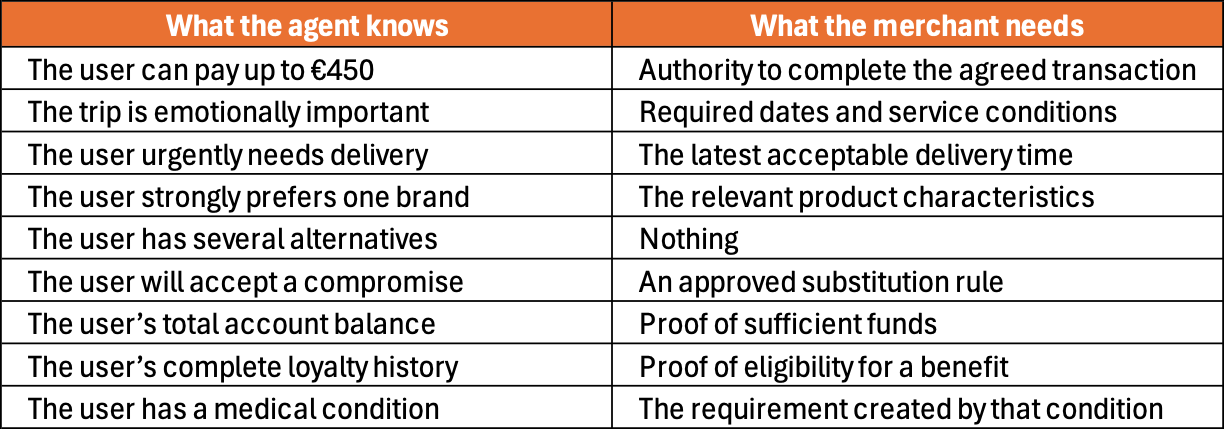
This is more than privacy hygiene. It is the preservation of bargaining power.
Merchant agents will probe for hidden constraints
Once agents negotiate, the attack surface expands beyond stolen credentials and unauthorized payments.
A merchant agent may ask how flexible the budget is, why the delivery date matters, which requirement is most important, what alternatives the customer has considered or how much more they would pay for immediate availability.
Each answer may improve the offer. It may also weaken the buyer’s position.
Even the agent’s behaviour can reveal private information. The speed of its replies, sequence of concessions, willingness to continue and pattern of counteroffers may expose hidden constraints without stating them explicitly.
A buyer agent may therefore protect the reservation price in its database while revealing it indirectly through its negotiation strategy.
Economic confidentiality must cover not only what the agent stores and transmits, but also how it behaves.
Agents need a duty of confidentiality
Most discussions of trustworthy agents focus on whether the agent followed the mandate. Did it purchase the correct item, remain within the spending limit and execute an authorized transaction?
Those are necessary questions, but mandate compliance is not enough.
An agent can follow the instruction and still damage the consumer. It may purchase within the maximum budget while revealing that maximum. It may select a suitable product while exposing sensitive personal information. It may obtain a personalized offer while giving the seller enough information to remove every available discount.
It may faithfully execute the mandate while surrendering the consumer’s surplus.
Agent governance therefore needs to distinguish three duties:
The duty of obedience
Follow the user’s explicit instructions.
The duty of care
Make a competent decision using the available information.
The duty of confidentiality
Do not unnecessarily disclose information that weakens or disadvantages the user.
The first is already becoming part of agent authorization systems. The second is increasingly treated as a model-quality problem. The third is barely being discussed.
Non-disclosure is not deception
There is an obvious danger here. If buyer and seller agents are both optimized to maximize financial outcomes, commerce could become a machine-speed contest in bluffing, probing and manipulation.
The answer cannot be to let agents fabricate offers, misrepresent eligibility or invent lower budgets. But neither can it be to force the buyer’s agent to reveal everything.
Agentic commerce will need a clear boundary between deception and legitimate non-disclosure. An agent should not lie about the user’s budget, but should be allowed to keep the true maximum private. It should not invent alternative offers, but may withhold which alternatives the user is considering. It should not misrepresent urgency, but need not explain why a deadline matters.
Human commerce already recognizes this boundary. Buyers are not normally required to reveal what they would have paid.
Agentic commerce should not quietly eliminate that protection.
The metrics are wrong
Most shopping agents will initially be judged using familiar commerce metrics: conversion, transaction completion, basket size, speed, relevance and merchant coverage.
Those metrics are useful for platforms and sellers. They are not sufficient for a consumer agent.
A highly converting agent may simply be very good at spending the user’s money. A fast agent may accept the first reasonable offer. A personalized agent may create higher merchant margins by exposing stronger signals of willingness to pay.
Consumer-aligned agents need different metrics:
consumer surplus retained;
savings against credible alternatives;
unnecessary information disclosed;
quality of buy-versus-wait decisions;
success in obtaining competing offers;
adherence to the user’s disclosure policy.
The ultimate test is not whether the agent completed the transaction. It is whether it improved the consumer’s position.
What this means for the market
The most important implication for merchants is not simply that they should collect less data. It is that data restraint could become a distribution advantage.
Consumer agents may eventually evaluate merchants not only on price, fulfilment and returns, but also on the information they demand. A merchant capable of producing a strong offer from minimal context may rank above one requiring the consumer’s full profile.
That turns data minimization from a compliance obligation into a competitive variable.
For builders, the opportunity is larger than a privacy setting. The ecosystem will need preference vaults, intent firewalls, selective proof systems, negotiation simulators, disclosure logs and adversarial testing that measures how easily merchant agents can infer hidden constraints.
For investors, a new infrastructure category may emerge between agent memory and transaction execution. It could be called private intent infrastructure, fiduciary agent infrastructure or economic confidentiality.
The label matters less than the function. Trusted agents will need more than permission to spend. They will need a protected place to think.
The next agentic-commerce right
Agentic commerce is beginning to define rights around identity, authorization, revocation and the ability to bring an agent into a commercial environment.
A further right may be required: The right to economic confidentiality
Consumers should be able to know what their agent disclosed, which disclosure changed an offer and whether the agent exposed information that weakened their position.
They should also be able to issue instructions such as:
Never disclose my maximum price. Do not reveal why the deadline matters. Prove I am eligible without sharing my full identity. Obtain the best available offer before revealing my preferred brand.
These may eventually become as normal as setting a spending limit.
The agent’s real advantage will be discretion
The first generation of shopping agents is being designed to understand us. That is necessary, but understanding the consumer is only half of representation.
A serious representative must also know what not to say.
The winning shopping agent may not be the one with the largest catalogue, the fastest checkout or even the richest memory. It may be the one capable of maintaining two models at once: a complete private model of the person it represents and a deliberately incomplete public model shown to the market.
The agent should know your preferences, constraints, urgency, alternatives and the point at which you would reluctantly say yes. It should not confuse knowing those things with permission to disclose them.
The future of consumer-aligned agentic commerce may depend on a simple principle:
The ideal shopping agent is maximally informed and minimally revealing.
Its advantage will not only be intelligence. It will be discretion.
🚀 Major Announcements & Funding News
Animoca Brands and Visa move agentic payments into a live merchant pilot: The companies began a Hong Kong deployment on Animoca’s Minds platform in which agents can identify eligible Visa benefits and complete purchases, initially through the Bruce Lee Club eShop. Tokenized payment credentials, authentication, user-defined permissions, transaction controls, and fraud protections are built into the flow (Animoca Brands)
Mastercard, maib, and Moldindconbank complete Moldova’s first agent-executed payments: The transactions used Mastercard Agent Pay and its Know Your Agent framework to register the acting agent, verify consumer intent, and authenticate payment authorization. The deployment provides a concrete model for binding an agent’s technical identity to a user-approved commercial mandate (Mastercard)
Akeneo introduces an agentic product-experience platform: Akeneo’s new architecture positions Agentic Ziggy as an orchestrator across enrichment, governance, activation, and product-data operations rather than as a standalone assistant. The significance for retailers is operational: product records may increasingly be maintained, evaluated, and distributed by coordinated agents before they are consumed by shopping agents (Akeneo)
Rezolve AI introduces auditable product recommendations: Auditable AI generates human-readable explanations for recommendations using verified customer preferences, product attributes, purchase history, and business rules. It joins Rezolve’s brainpowa and TraceWare components, which address recommendation accuracy and agent-action traceability (Rezolve AI)
NIQ and Lula Commerce connect structured product content to retail execution: NIQ’s Brandbank-based Product Intelligence will supply complete product records and structured attributes to Lula’s ordering, marketplace, delivery, and digital-store platform. Lula says it supports more than 165 regional brands across 44 US states (NIQ)
Quiq launches a control layer for customer-facing agents: Verified Intelligence combines pre-deployment simulations, behavioral guardrails, claim verification, and step-by-step visibility into agent decisions. The product is designed to let enterprises test and audit customer-service agents before granting them broader authority (Quiq)
Tangos raises a $20 million seed round for autonomous financial-crime investigations: Red Dot Capital Partners led the financing. Tangos uses agents to assemble regulator-ready investigation files, including evidence, reasoning, audit trails, and case documentation, for banks and other regulated institutions (Tangos)
Kord raises £6.4 million to combine onboarding, compliance, and payments: Guinness Ventures led the round. Kord is building a unified operating layer for identity verification, AML checks, digital onboarding, signing, payments, wallets, and client-money administration in regulated sectors (Tech.eu)
AEON connects its payment platform to Bolivia’s national QR infrastructure: The OpenBCB integration lets customers pay at supported merchant QR codes using digital assets while merchants receive settlement in Bolivian bolivianos. AEON presents the connection as localized settlement infrastructure for both human- and agent-initiated commerce (AEON)
Cresta launches agent-based simulation for contact-center training: Training Simulator creates adaptive simulated customers grounded in a company’s actual conversation data. Human agents can rehearse sales, retention, service, and escalation scenarios without relying on scripted role-play or supervisor availability (Cresta)
Komrz launches Komi as part of its agentic-commerce repositioning: Formerly Shahbandr, the company says Komi will let merchants use text commands to manage operating tasks, storefront content, analytics, and customer engagement. Komrz reports a base of more than 20,000 merchants in Saudi Arabia and Egypt and plans expansion across the GCC and Europe (ZAWYA)
🛡️ Security & Fraud
Dun & Bradstreet brings verified business-risk data into Cursor through MCP: The integration lets developers incorporate D&B commercial-graph and risk intelligence into compliance, procurement, and other agentic workflows. The product targets a basic enterprise-agent problem: models cannot make reliable counterparty decisions from unverified public context alone (Dun & Bradstreet)
Veriff identifies anonymity as the central agentic-commerce fraud risk: Its analysis argues that a merchant must be able to connect the consumer, acting agent, payment instrument, and commercial mandate. Static verification at account creation is insufficient when an agent’s permissions, ownership, or behavior may change later (Veriff)
Chargeflow maps the unresolved merchant-liability problem: The analysis highlights disputes involving agents that exceed spending limits, misinterpret instructions, perform rapid credential tests, or manipulate pricing and refund processes. Durable consent records, revocation controls, transaction scope, and agent-level dispute evidence will be required (Chargeflow)
Agent-mediated transactions create a fraud-signal gap: Legitimate agents may operate without stable devices, cookies, browsers, locations, or behavioral histories, making them resemble conventional bots. Risk systems will need to evaluate delegated authority, intent, scope, and revocation status rather than relying mainly on device reputation (New Harbor Institute)
Payment-security controls are generating measurable commercial friction: A PYMNTS Intelligence survey of 60 US middle-market CFOs found that 55% had experienced security-related payment delays, while 85% said automation could improve speed and protection by reducing manual review. Firms reporting recurring friction estimated that delays, errors, fraud, and remediation consumed 1.92% of revenue, compared with 0.31% among lower-friction firms (PYMNTS)
OpenBox AI and Temporal introduce runtime authorization for long-running agents: The integration combines durable agent execution with real-time authorization, human approvals, attestations, recoverability, and audit trails. The architecture addresses agents whose permissions or operating context may change while a commercial workflow is still running (OpenBox AI)
Phia faces scrutiny over affiliate-attribution behavior: Independent testing reported that the shopping assistant sometimes generated affiliate clicks or inserted referral attribution without the shopper deliberately clicking through to the merchant, potentially overriding another publisher’s referral. Phia said the behavior was a misattribution issue affecting a subset of sessions and had been corrected; Impact.com reportedly suspended the company while reviewing the matter (Inc.)
📈 Consumer & Market Insights
AI Commerce Rankings produce a different retail leaderboard from ecommerce sales rankings: Digital Commerce 360 and ReFiBuy scored 1,000 retailers on bot accessibility, AI-referred traffic, source diversity, and 90-day momentum. Early leaders included Online Labels, Nixon, Fashionphile, Everlane, and Brooklinen, suggesting that ecommerce scale does not guarantee machine visibility (Access Newswire)
Online grocery is emerging as a practical test for delegated shopping: Coresight Research’s latest survey analysis examines how assistants affect grocery discovery, basket construction, and purchase decisions. It also highlights subscription customers, including Amazon Prime and Walmart+ members, as an important population for understanding comfort with AI-enabled grocery buying (Coresight Research)
Adobe Commerce reports stronger conversion from AI-referred shoppers: Its sponsored Retail Dive analysis says AI-referred visitors convert 42% better than other traffic, remain on merchant sites longer, and spend more per visit. The commercial benefit still depends on site speed, relevant search, personalization, consistent product data, and a reliable transition from the agent to the merchant (Retail Dive / Adobe Commerce)
Invoca reports high purchase intent among ChatGPT-referred callers: Its analysis of 70 million voice and messaging conversations found that calls attributed to ChatGPT produced a 49% lead rate—around ten percentage points above the cross-channel average—although ChatGPT still represented a small share of total call volume. The figures are company-reported and measure businesses where phone conversations remain part of the conversion process (Invoca)
European consumers are experimenting with AI but resisting full purchasing delegation: Deloitte surveyed 13,500 consumers in 15 European countries and found that 56% had used AI during a shopping journey. Among AI users, 57% used it for product comparisons, but only 8% were willing to delegate an entire purchase; privacy and security, manipulation, and loss of human contact were the leading concerns (Deloitte)
🎯 Strategic Hiring Highlights
Product / platform / architecture
American Express — Director of Product Development, Agentic Commerce Growth & Emerging Capabilities — New York, NY — $144,250–$256,250 — American Express Careers
Citi — Senior Vice President, Product Development – Wallets & Agentic Commerce | US Consumer Cards — New York, NY (hybrid) — $176,720–$265,080 — Citi Careers
Amazon — Principal Product Manager Technical, Agentic Commerce Experiences — Seattle, WA — Salary band not listed; posted June 19, 2026 and live into July — Amazon Jobs
Wesfarmers Digital — Agentic Commerce Product Manager — Sydney, Australia (hybrid) — Salary not listed — Wesfarmers Digital Careers
Gap Inc. — Principal – Architecture (AI, Unified Commerce) — San Francisco, CA — $209,700–$272,600 — Gap Inc. Careers
Mirakl — Senior Product Manager, Agentic Commerce Infrastructure (Mirakl Nexus) — Paris or Bordeaux, France — Salary not listed — Mirakl Careers
SAP — Senior Product Specialist, Agentic AI – Retail (f/m/d) — Walldorf, Germany — Salary not disclosed — SAP Careers
SAP — Product Expert, Agentic AI – Retail (f/m/d) — Walldorf, Germany — Salary not disclosed — SAP Careers
Bloomreach — Vice President & GM, Product Management, Commerce AI — Remote / United States — Salary not listed — Bloomreach
Seed — Senior Product Manager (Agentic / AI‑native product) — Remote, US — $180,000–$195,000 + equity — Greenhouse
Engineering / infra / Agentic AI
SAP — Senior Agentic AI Engineer — Palo Alto, CA — US$131,000–US$222,700 targeted combined compensation — SAP Careers
TaxBit — Agentic AI Engineer — Salt Lake City, UT (hybrid) — US$130,000–US$170,000 — TaxBit
The Trade Desk — Staff Software Engineer – Agentic AI — London, UK — Salary not disclosed — The Trade Desk Careers
General Dynamics IT — Agentic AI Engineer — Falls Church, VA — Salary not disclosed — GDIT Careers
📖 Articles Worth Reading
Why agentic commerce will matter more than ChatGPT ads: The analysis argues that product feeds, structured data, merchant APIs, inventory, and transaction access will become more important than conventional advertising placement when agents can compare and act directly. The merchant connection itself may become the new commercial unit (Search Engine Land)
The future of travel distribution: AI, modern retailing and intelligent orchestration: Amadeus examines how agents can coordinate fragmented airline, hotel, transport, servicing, and pricing systems. The near-term value is likely to emerge in assisted search, selling, disruption handling, and servicing before fully autonomous trip purchasing (Amadeus)
Agentic commerce is built. The rulebook isn’t: Payment Expert’s interviews with Worldpay, Silverflow, and Equals show that the remaining obstacles are identity, delegated authority, liability, disputes, and mutual recognition between competing agent standards. The technology is moving faster than the legal and commercial settlement model (Payment Expert)
Why AI agents will not take over the entire ecommerce industry: Epoq challenges the idea that all shopping will migrate to autonomous agents. Repeat purchases with clear preferences are easier to delegate, while inspiration, emotional involvement, uncertain preferences, and experiential categories preserve a role for stores and human judgment (Epoq)
Agentic Commerce, Part 2: Who Gets to Transact: Activant Capital organizes the enablement layer around access, identity, settlement, governance, and liability. Its strongest conclusion is that commercial returns may accrue to infrastructure controlling transaction permission, rather than to the most visible consumer assistant (Activant Capital)
Winning the AI decision layer: Search Engine Land presents a readiness framework spanning machine access, structured information, authority signals, comparison data, transaction integration, and post-purchase support. A merchant cannot compete for agent selection when its catalog and commercial terms are difficult to interpret.- (Search Engine Land)
AI shopping in 2026: The agentic inversion: nShift extends agent readiness beyond products and prices to delivery promises, locations, service levels, returns, and fulfillment constraints. An offer is not fully machine-readable when an agent cannot determine whether it can be delivered or returned under acceptable conditions (nShift)
Agentic commerce is reshaping retail—and most operating models are not ready: Total Retail argues that agents cut across merchandising, marketing, ecommerce, service, data, and operations, making fragmented ownership a major deployment risk. Retailers may need shared metrics and decision rights rather than isolated experimentation inside individual functions (Total Retail)
Travel visibility, trust and conversion take focus amid the agentic-commerce shift: PhocusWire examines how travel suppliers may lose visibility when agents mediate comparison and booking. Structured inventory, trusted content, servicing capability, loyalty access, and reliable conversion paths become more important when the traveler does not visit every supplier interface (PhocusWire)
No trust, no trade: Why agentic commerce depends on data and permission: Planet argues that agent readiness depends less on storefront design than on structured product information, reliable inventory and fulfillment data, consent, system access, and clear liability (Planet)
AI agents want to shop for you: The future of agentic commerce: MIT’s Initiative on the Digital Economy examines the design, regulatory, and trust questions created when agents move from generating recommendations to executing commercial decisions (MIT Initiative on the Digital Economy)
🧭 Looking Ahead
NRF Nexus 2026
Date: July 22-24, 2026
Location: Colorado Springs, USA
Focus: Executive retail technology summit with AI commerce and agentic operating-model themes
Berkeley Agentic AI Summit 2026
Date: August 1-2, 2026
Location: Berkeley, CA
Focus: Agentic AI research, infrastructure, interoperability, governance, and academic-to-industry transfer
eTail Boston 2026 / eTail East
Date: August 10-12, 2026
Location: Boston, USA
Focus: Ecommerce and omnichannel operations, with AI commerce and digital-commerce execution themes
Stripe Tour Sydney
Date: August 19, 2026
Location: ICC Sydney
Focus: Payments, software platforms, AI-commerce tooling, and internet-economy growth
Stripe Tour Singapore
Date: August 25, 2026
Location: Sands Expo and Convention Centre
Focus: Regional payments, cross-border commerce, AI-enabled business infrastructure
W3C / GS1 Workshop: E-commerce for Humans and AI Agents
Date: September 8-9, 2026
Location: Zurich, Switzerland / hybrid
Focus: Standards, interoperability, product data, identity, and agent participation in ecommerce workflows
MRC San Diego 2026
Date: September 14–16, 2026
Location: Hyatt Regency Mission Bay Spa and Marina, San Diego
Focus: Payments, fraud prevention, chargebacks, merchant risk, and digital-trust operations
Agentic Commerce & Payments Summit 2026
Date: September 15, 2026
Location: Stockholm, Sweden
Focus: Agentic AI in commerce and payments, intelligent transactions, automation, fraud prevention, and AI-driven decisioning
Money20/20 USA 2026
Date: October 18–21, 2026
Location: Las Vegas, NV
Focus: Payments, fintech, financial services, connected commerce, banking partnerships, and money-movement infrastructure
General information only. Not legal, tax, investment, or professional advice. No warranty as to accuracy or completeness. Verify independently and consult your own advisers.
If you believe any information is inaccurate, please contact AgenticCommerce@proton.me and we will make a good-faith effort to review and correct it where appropriate.
Sponsored or affiliate content, if any, is disclosed.