
The Agentic Commerce Frontier 📅 | February 24 – March 9 2026


Thanks for subscribing. This issue covers February 24, 2026 through March 9, 2026, Here are some of the big stories: Stripe and Klarna pushed BNPL deeper into AI-agent checkout, and Mastercard and Santander demonstrated a regulated live AI-agent payment in Europe. At the same time, fraud leaders are adopting AI almost universally while still adding people and budget, which says a lot about how messy the real operating environment still is.
My post this week adresses the much talked about “OpenAI scale-back from Agentic Commerce”. Needless to say, I think many analysts are over-reacting and concentrating on the noise. But I think that if we dig deeper, just a little, signal will reveal itself.
Please reach out to chat or if I can help with anything. Drop me a message at AgenticCommerce@proton.me. Happy reading!
🔥 TL;DR
Klarna joined Stripe’s Shared Payment Tokens path for AI-agent checkout, extending BNPL into agentic commerce for U.S. merchants already live with Klarna via Stripe
My takeaway: BNPL is going to do magic to Agentic Checkout. Particularly excited about BNPL aggregation in this space
Stripe expanded agentic payment support to include Mastercard Agent Pay, Visa Intelligent Commerce, and BNPL methods including Affirm and Klarna
My takeaway: Stripe doing what it does best: built infrastructure and orchestrate
Mastercard and Santander completed Europe’s first live end-to-end AI-agent payment inside a regulated banking framework, a milestone for trusted autonomous transactions
My takeaway: Significant for highly regulated Europe, though we’re still waiting for the standards and protocols to arrive in Europe (UCP)
OpenAI appears to be stepping back from native checkout inside ChatGPT, with purchases shifting toward merchant apps and retailer-controlled experiences
My takeaway: See my piece below
Mastercard and Google open-sourced Verifiable Intent, a new trust layer for agentic commerce aimed at standardizing authorization and machine-verifiable intent
My takeaway: Scaffolding, but indispensable for scale and sustainability
🤖 Agentic Commerce Primer: On OpenAI “scaling back” in Agentic Commerce
The Most Valuable Layer in Agentic Commerce May Come Before Discovery
TL;DR: ChatGPT isn’t failing as a store; it’s just too early. The real power is upstream: using long‑term memory to turn messy life context into buying constraints, and whoever owns that constraint‑setting layer will quietly control the shortlist … and most of the purchase decisions
Most commentary I’ve read stops at “ChatGPT behaves more like search than a store.” This piece starts one step earlier.
Over the last week, everyone has had a theory about OpenAI scaling back checkout in ChatGPT. Agentic commerce was overhyped. Merchants pushed back. Users didn’t trust a chatbot with their card. All of those takes orbit the same surface question: can ChatGPT be a store?
The more interesting question is where an AI assistant actually gains power in the shopping journey. The early usage pattern is clear on one point: people today use ChatGPT heavily for research and comparaison, then go elsewhere to buy. That already puts it upstream of checkout. As assistants accumulate long-term memory and see more of how we live, the real leverage is likely to move even further upstream, into the step where memory and context are turned into constraints that decide whatever makes it onto the shortlist.
1. From “Store” to Intent and Constraints
So where does ChatGPT actually sit in the commerce stack today?
The initial instinct was to map an Amazon-like mental model onto it: a new super-store, with a conversation as the UI. The observed behavior points toward something different. Users don’t show up saying “SKU 12345.” They show up with problems:
“Best laptop for video editing under 1500 that won’t sound like a jet engine.”
“We’re having our first baby in a small apartment with no car. What stroller and crib setup makes sense?”
“I travel to the US 6–8 times a year from Europe and want to stop checking bags; what luggage should I get?”
These are messy situation descriptions, not clean product queries. The job ChatGPT is doing is to turn that context into a structured set of constraints and a shortlist of options, with reasoning attached.
Most of those journeys still end with a click-out: the buy happens on Amazon, a brand site, or a merchant app, not inside ChatGPT’s own checkout. Studies of ChatGPT traffic show the same pattern at scale: high-intent research and pre-qualification inside ChatGPT, with conversions attributed to branded search or direct traffic when people finally check out elsewhere.
Seen through that lens, the design problem changes.
Designing for “we are the store” means optimizing conversion, checkout completion, and card-on-file. Designing for an intent + constraint layer means optimizing:
the quality and stability of the shortlist
how well trade-offs are exposed and explained
how cleanly rich intent and constraints can be handed off to sites, apps, and agents that own execution
OpenAI’s recent emphasis on discovery and ads fits this model: monetize attention and high-intent problem statements, then let transactions happen where trust and logistics are already strong.
But even that understates the most important advantage an assistant like ChatGPT can have. To see that, it helps to look one step earlier.
2. The Real Power Sits Before Discovery: Memory → Constraints → Shortlist
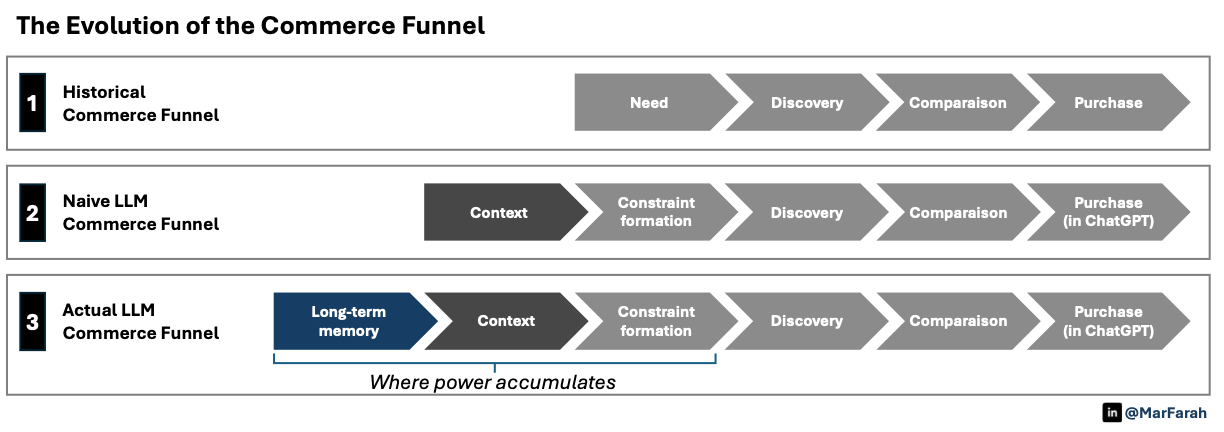
Commerce funnels are usually described as:
Need → Discovery → Comparaison → Purchase
A more honest view of that funnel inserts a step that usually goes unmentioned:
Context → Constraint formation → Discovery → Comparaison → Purchase
Context is what you tell the assistant about the specific situation right now.
Constraint formation is the step where the assistant turns current context into concrete filters the market understands.
But with persistent memory in LLMs, the new funnel actually might look like this:
Long‑term memory → Context → Constraint formation → Discovery → Comparaison → Purchase
Constraint formation becomes the step where the assistant turns long‑term memory + current context into concrete filters the market understands.
In real life, people are constantly translating messy context into constraints that systems can understand:
“Two kids and no car” becomes “stroller that folds small, is light enough to carry, and fits in ride-shares”
“We host often but hate clutter” becomes “modular seating, durable fabric, tight dimensional constraints”
“More work travel, tired of checking bags” becomes “carry-on size, overhead-bin compliant, durable, mid-tier price”
Historically, almost nobody saw that upstream translation. Retailers saw search terms and SKUs in carts. Payment networks saw amounts and merchant IDs. Even close friends and partners only saw fragments of the reasoning.
A regularly used assistant like ChatGPT has the potential to see and remember the upstream layer:
conversations about living space, commute, family, and health constraints
repeated regrets and satisfactions (“too big,” “too fragile,” “worth the extra money”)
stable trade-off patterns: where someone predictably splurges or saves
anxieties, concerns, wishes, and long-running patterns that rarely show up in a search box
With persistent, cross-session memory, an assistant can build a structured, longitudinal model of a person’s constraints and preferences across domains in a way no individual retailer, bank, or social graph can.
By the time someone says “I need a TV,” a well-tuned assistant can already infer likely size, brightness needs, viewing distance, platform preferences, and budget based on months of prior context. By the time someone says “help us plan for a baby,” the assistant can incorporate storage limits, lifestyle, and financial constraints that surfaced in entirely different conversations.
Constraint‑setting stops being a single moment right before discovery. It becomes an ongoing process shaped by everything the assistant remembers. Once constraints are in place, everything downstream collapses into a shortlist. And that is where power concentrates:
Whoever defines the constraints defines the shortlist. Whoever defines the shortlist shapes most purchases.
Search engines historically competed on ranking within user-supplied filters. Marketplaces competed on catalog depth and logistics. A memory-rich assistant competes on defining the box itself: what should be in scope before a list ever appears.
From a strategic perspective, that upstream layer, memory-driven constraint-setting and shortlist formation, is where leverage is likely to be most durable. Checkout matters. Ranking matters. But the actor that quietly shapes the shortlist, based on a deeper view of the user than anyone else has, will exert disproportionate influence on commerce.
There is an obvious caveat here: this only becomes durable if users trust the assistant enough to let it remember high-value life context, and if platforms and regulators are comfortable with how that memory is used commercially. That trust layer is not a side issue; it is part of the strategy.
3. From First Principles, the Sequence Looks Different
Viewed from first principles, OpenAI’s recent adjustments look less like a reversal and more like the beginning of a more robust sequence. A sensible order of operations might look like this:
Make memory and constraint-setting first-class: Treat ChatGPT as a place where people externalize constraints: budgets, risk tolerance, recurring needs, “never again” categories, accessibility rules
Offer ways to inspect and adjust that constraint profile: Much like editing saved addresses or payment methods
Build and evolve standards for expressing intent and constraints: ACP today focuses on safely moving orders and payments between agents and merchants. Over time, protocols like ACP could grow into richer intent layers, where an assistant can say not just “buy this,” but “here is the constraint set this purchase needs to satisfy.” That’s not the current spec; it’s the natural direction if assistants become the main constraint-setting surface
Treat partner apps as execution venues: In the near term, let Instacart, Target, Expedia, Booking and others own checkout, logistics, and risk; focus on handing off high-quality, fully formed intent into their flows
Monetize discovery and constraint-matching ahead of the transaction: Use ads and sponsored placements to monetize high-intent queries and shortlists, ideally with alignment around constraint quality: prominence in exchange for satisfying clearly expressed constraints, not just paying to appear
As standards harden and behavior shifts, selectively expand native checkout in domains where the assistant can clearly add incremental value without overwhelming operational risk
In that sequence, agentic commerce doesn’t shrink; it shifts. Instead of centering everything on a universal “Buy in ChatGPT” button, the emphasis moves to an invisible layer that translates human life into machine-readable constraints and routes demand to the right places, with checkout as one possible endpoint, not the only one.
OpenAI’s decision to pause broad native checkout does not show that the idea of AI-driven shopping was a mistake. It shows that trying to stand at the very end of the funnel before owning memory, constraints, and standards is brittle.
If a bet has to be placed on where AI will create the most durable leverage in commerce, it is unlikely to be on the “Buy” button itself. The more promising bet is on the upstream layer where an assistant learns how a person actually lives, turns that into constraints, and, by doing so, quietly narrows whatever reaches the shelf.
A follow-up piece will look specifically at what this shift implies for Stripe and the broader payments ecosystem.
🚀 Major Announcements & Funding News
Klarna expands further into agentic commerce via Stripe Shared Payment Tokens: Klarna said its flexible payment options will soon be supported in AI agent-driven shopping through Stripe’s Shared Payment Tokens, bringing BNPL into permissioned agent checkout for U.S. merchants already live with Klarna on Stripe (Klarna)
Stripe adds more agentic payment methods: Stripe said it is expanding Shared Payment Token support to include Mastercard Agent Pay, Visa Intelligent Commerce, and BNPL methods such as Affirm and Klarna, positioning itself as a multi-rail orchestration layer for agentic payments (Stripe)
Santander and Mastercard complete Europe’s first live AI-agent payment: Santander and Mastercard announced a live end-to-end payment executed by an AI agent inside a regulated banking framework, giving the market an early real-world reference point for compliant agentic payments in Europe (Santander)
Mastercard and Google launch Verifiable Intent: Mastercard said Verifiable Intent is being open-sourced as a standards-based trust layer for agentic AI commerce, with reference implementation code and developer tools to follow (Mastercard)
PayPal is recognized as the AI-talent leader in payments: PayPal said the 2026 Evident AI Index for Payments ranked it first in AI Talent and second in Innovation, reinforcing how aggressively the major payment platforms are staffing for AI-native commerce (PayPal)
Brex launches inside ChatGPT: Brex said it is now available in the ChatGPT app marketplace, giving ChatGPT Enterprise users conversational access to expense data, limits, reimbursements, and policy information in a read-only workflow (Brex)
Nexi launches new agentic commerce capabilities: Nexi introduced a new Model Context Protocol (MCP) that lets developers, merchants, and partners connect AI agents to its payment capabilities through conversational commands, positioning the company as infrastructure for automated payment workflows in Europe (Nexi)
Nexi and Google Cloud collaborate to drive agentic commerce across Europe: Nexi and Google Cloud said they will work together on infrastructure for agent-initiated payments, with support for open standards including AP2 and UCP to enable secure, authorized AI-led shopping and payment journeys (Nexi)
ZyG raises $58M to scale an agentic e-commerce platform: ZyG, founded by the creators of ironSource, raised $58 million in seed funding for an AI platform that predicts product demand and helps launch and run e-commerce brands with automation and financing built in (SiliconANGLE)
Azoma unveils Agentic Merchant Protocol (AMP): Azoma launched Agentic Merchant Protocol (AMP), a framework designed to help enterprise brands define, distribute, and govern how their product catalogs are interpreted by AI agents, making it a notable addition to the emerging merchant-side standards layer in agentic commerce (Azoma)
🛡️ Security & Fraud
SEON’s 2026 Fraud & AML Report shows AI is universal, but complexity is rising: SEON found 98% of organizations already use AI in fraud and AML workflows, yet 94% still plan to increase headcount and 83% expect budgets to rise, suggesting operational complexity is outrunning automation gains (SEON)
Fragmentation remains the core operating problem: SEON found that while 95% of respondents report some fraud/AML integration, only 47% run fully integrated workflows and 80% struggle to get a unified view of data (SEON)
Recorded Future/Mastercard warn payment fraud is becoming more automated and industrialized: Mastercard’s summary of the new Recorded Future report says attackers are using AI and standardized tooling to scale credit-card compromise, fake storefronts, OTP theft, and payment-page skimming. Mastercard notes that although agentic commerce is still early, it could introduce new vulnerabilities, investigation complexity, and liability questions, which is why standards and trust layers are moving to the front of the roadmap (Mastercard / Recorded Future)
Riskified expands AI Agent Intelligence to secure native merchant AI shopping assistants: Riskified expanded its AI Agent Intelligence platform to protect merchants’ conversational shopping assistants from fraud and abuse, making it directly relevant to agent-led transactions and AI-native commerce interfaces (Riskified)
DataDome and Botify partner to give businesses full control over agentic commerce, from discovery to transaction: DataDome and Botify announced a March 5, 2026 partnership to help businesses optimize agentic commerce while ensuring AI agents can discover products and transact securely, making it directly relevant to trust, bot management, and fraud control in AI-led commerce flows (DataDome)
📈 Consumer & Market Insights
Adyen says APAC checkout abandonment can hit 68%: Adyen’s 2026 APAC payments outlook argues that the conversation is shifting from payment-method breadth to customer recognition quality, with infrastructure quality increasingly determining conversion (Adyen)
Mastercard sees consumer usage already ahead of enterprise comfort: Mastercard says 39% of U.S. consumers have used generative AI for online shopping and 53% planned to do so in 2025, underscoring demand for AI-assisted commerce before the governance stack is fully mature (Mastercard)
Forsta’s latest retail study shows AI is shaping discovery more than transactions: Forsta says 1 in 3 U.S. shoppers used AI during the holiday season, 69% were satisfied with AI-powered shopping experiences, 87% used AI primarily for inspiration rather than transactions, and 58% bought based on an AI recommendation (Forsta)
OpenAI’s commerce retreat points to a handoff model, not full-stack AI checkout: Reports that OpenAI is scaling back direct checkout inside ChatGPT suggest that AI may remain strongest in discovery, recommendation, and intent capture while merchants, apps, and payment providers retain the transactional layer (The Information)
Netcore’s 2026 report frames agentic commerce as an operating-model shift: Netcore’s Agentic Commerce Shift Report 2026 argues that brands are moving from campaign-based execution to always-on, profit-oriented agentic systems, which is directly aligned with the broader transition in commerce orchestration (Netcore)
🎯 Strategic Hiring Highlights
Stripe — Senior Staff Product Designer, Agentic Commerce — San Francisco, CA / New York, NY / Seattle, WA / Remote in United States — (Salary Not Disclosed) (Stripe Careers)
Swap — Head of Product (Agentic Commerce) — Remote (Africa / Europe time zones; HQ London, UK) — (Salary Not Disclosed) (Swap Careers)
Affirm — Senior Product Manager, Digital Wallets – Agentic Commerce — United States – Remote — (169,000–240,000 USD per year) (Affirm Careers)
Mastercard — Director, Agentic Commerce Solution Engineering — San Francisco, CA / Singapore, SGP — (Salary Not Disclosed) (Mastercard Careers)
📖 Articles Worth Reading
OpenAI Scales Back Shopping Plans for ChatGPT: The clearest signal yet that AI-led discovery may scale faster than AI-owned checkout, and that merchant apps may retain the decisive conversion layer for now (The Information)
OpenAI’s big ChatGPT Instant Checkout plan just changed: A useful summary of the same pivot and what it implies for retailers, marketplaces, and measurement (Search Engine Land)
How Verifiable Intent builds trust in agentic AI commerce: Mastercard’s framing of trust, verification, and machine-readable intent is one of the more concrete attempts to define the control plane for agentic transactions (Mastercard)
5 Payment Trends to Watch for in 2026: J.P. Morgan’s latest trends piece is broader than agentic commerce, but it is useful for situating identity, fraud, tokenization, and always-on payment infrastructure in the same strategic frame (J.P. Morgan)
SEON’s 2026 Fraud & AML Report: While AI Is Everywhere, Fraud Teams Are Still Growing: One of the best operating-reality reads of the period because it shows why fraud infrastructure, not just AI models, will determine who can safely scale agentic commerce (SEON)
How payments fraud is growing in scale and sophistication: Mastercard’s summary of Recorded Future’s report is a useful briefing on the threat landscape AI-enabled commerce inherits (Mastercard / Recorded Future)
🧭 Looking Ahead
Shoptalk Spring 2026
Date: Mar 24–26, 2026
Location: Las Vegas, USA
Focus: UCP/AP2 roadmaps, agentic demos, and merchant case studies
Chatbot Summit Berlin 2026
Date: March 25, 2026
Location: Berlin, Germany
Focus: “Mastering Agentic AI,” with explicit “agentic commerce in action” themes and implementation learnings
Agentic Commerce Summit
Date: April 13-15, 2026
Location: London, United Kingdom
Focus: A rare event focused directly on autonomous AI agents in retail, agent payments, and commerce protocols; highly relevant for tracking standards, trust, and orchestration debates.
Syndigo Connect 2026 — AI Commerce & Agentic Product Experiences
Dates: April 14–16, 2026
Location: Bellagio, Las Vegas, USA
Focus: Billed as “the premier conference for AI-driven product experiences and agentic commerce,” centered on AI-ready product data, retail media, and connected experiences that determine how agents discover, compare, and buy across channels
NexGen Retail Summit, London
Dates: April 15–16, 2026
Location: Hilton Hotel, London, UK
Focus: Retail tech summit on AI’s transformation of commerce—sessions span “The $1 Trillion AI Retail Revolution,” predictive commerce, omnichannel, frictionless payments, and Responsible AI in Retail
Adobe Summit 2026 — Commerce programming (“Adobe Commerce Summit” track coverage)
Date: April 19–22, 2026
Location: Las Vegas + Online
Focus: Adobe is explicitly framing sessions around agentic/generative AI; Commerce sessions and labs are a strong proxy for enterprise merchant readiness
Money20/20 Asia
Date: Apr 21–23, 2026
Location: Bangkok, Thailand
Focus: Cross-border rails (licenses, FX, A2A), wallets, and agentic acceptance
Money20/20 Europe 2026 — “AI and the Agentic Age” Content Pillar
Dates: June 2–4, 2026
Location: RAI Amsterdam, Amsterdam, Netherlands
Focus: Europe’s #1 fintech event; 2026 agenda adds an “AI and the Agentic Age”pillar explicitly covering agentic commerce & finance, multi-agent ecosystems, and identity/ethics
NRF 2026: Retail’s Big Show Europe — The Next Now
Dates: September 15-17 2026
Location: Paris Expo Porte de Versailles, France
Focus: Europe’s flagship NRF gathering. Expect heavy airtime on AI-driven retail operating models, retail media + personalization, and the emerging “agent-ready” stack
Ran this experiment myself - gave my agent $25 and told it to buy a gift, fully autonomous. Three hours, no purchase. Bot detection at checkout, payment auth loops, silent transaction blocks with zero error message. The AMP and Nexi infrastructure looks solid for the enterprise layer. But the long tail of merchants - where most real shopping actually happens - is not being touched. ZyG addresses supply side automation. The demand side friction (checkout systems, fraud detection flagging agents, payment auth flows) is where it breaks for real users right now. The SEON fraud complexity note makes sense from my side too. The same systems blocking fraud are blocking legitimate agent purchases. That tension still needs a standard.